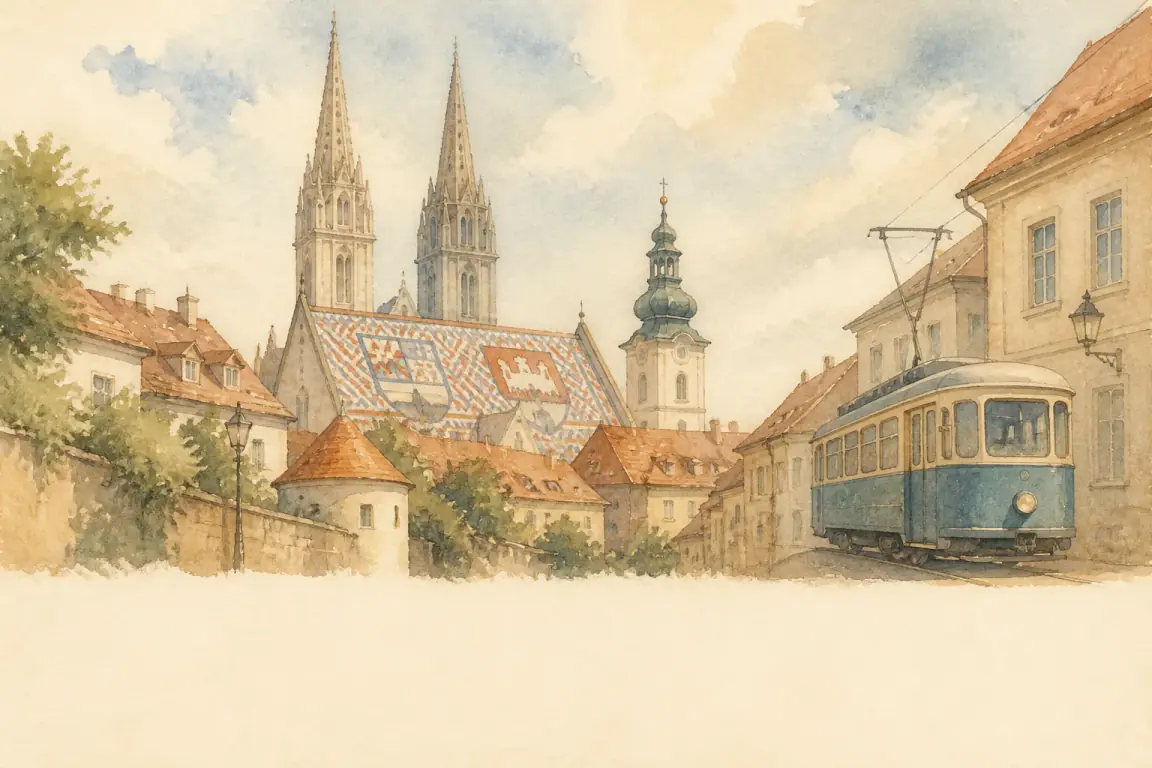
Zagreb holidays
Compact inland capital combining walkable Austro-Hungarian streets with cafe-led Lower Town and quieter hilltop Upper Town.
28°C AugustBest Jun, Jul, Aug, Sep2–4 nightsDirect from Paphos
At a glance
- urban stopovers on Balkan routes
- travellers pairing city with coastal leg
- weekend capital breaks
Trip cost
- Return flight
- ≈€67
- Stay
- ≈€440
- Food & local
- ≈€96
Includes the return fare from Paphos. An estimate, not a quote — each booking happens separately with its supplier. How we work this out.
Stays
Stays in Zagreb
Typically around €64/night, a Croatia-wide estimate · €110 mid-range — not a live listing price
Map
Review or change this anytime on our privacy page.
Getting to Zagreb
- AirportZagreb Airport (Franjo Tuđman) (ZAG)
- Transfer optionsBus, taxi
Zagreb Airport connects to the centre by the dedicated Pleso Prijevoz shuttle to the main bus station and by ZET city bus route 290 to Kvaternik Square, plus taxis and ride-hailing.
We haven’t found enough fresh fares for these dates yet.
Check flights on Aviasales (opens in a new tab)Areas of Zagreb
A few places people base themselves, and who each tends to suit.
- Lower Town (Donji Grad)Best for first-time visitors wanting hotels, museums, parks and tram links in a largely flat central area.
- Upper Town (Gornji Grad)Suited to travellers prioritising characterful lanes, viewpoints and evening cafes over direct tram access and flat streets.
- KaptolAppeals to those wanting cathedral proximity and nightlife around Tkalčićeva while remaining close to both Upper and Lower Town.
- Novi ZagrebGood for budget-conscious visitors or groups who prefer larger modern apartments and easy road access over historic surroundings.
- Britanski Trg areaWorks for longer stays and digital nomads wanting a residential base with markets and tram links into the centre.
When to go
Monthly climate normals (multi-year reanalysis data). Gold months are the best weather fit.
- Best overall
- June · July · August · September
- Hottest
- July · 29°C
- Wettest
- May · 107mm
- Jan6°72mm
- Feb10°41mm
- Mar13°66mm
- Apr16°72mm
- May20°107mm
- Jun27°59mm (good month)
- Jul29°81mm (good month)
- Aug28°79mm (good month)
- Sep23°94mm (good month)
- Oct17°73mm
- Nov10°91mm
- Dec6°69mm
What each season is like
- Spring
- Parks and cafe terraces fill without peak summer heat; this is comfortable for walking the Green Horseshoe and hill streets.
- Summer
- Some locals leave for the coast, so the city can feel quieter by day yet warm for uphill walks, with occasional festivals in open squares.
- Autumn
- Pleasant for museum and cafe-focused stays; rainier spells and shorter days make outdoor time more compressed later in the season.
- Winter
- Christmas markets add interest but cold spells and early darkness can make hill sections less appealing for extended walking.
What’s on in Zagreb
See all events in Zagreb on Wanderistan (opens in a new tab)
Compare Croatia destinations
Still deciding? Other Croatia destinations, with the same weather and typical-stay data behind them.
Good to know about Zagreb
Worth it for
Offers a Croatian city break away from the coast, contrasting with Split, Zadar and Dubrovnik's seaside focus.
Keep in mind
Lacks coastal setting, so does not provide sea or beach days that many Croatian visitors expect.
Why go
- Offers a Croatian city break away from the coast, contrasting with Split, Zadar and Dubrovnik's seaside focus.
- Gives a stronger cafe and street-life mix than many smaller regional towns while remaining easier to navigate than Vienna or Budapest.
- Works as an overnight stop on overland routes between central Europe and the Adriatic, which coastal cities do not.
Worth knowing
- Lacks coastal setting, so does not provide sea or beach days that many Croatian visitors expect.
- Upper Town and Kaptol involve slopes and cobbles which may challenge some travellers.
- Airport has no rail link, so transfers rely on buses or road vehicles.