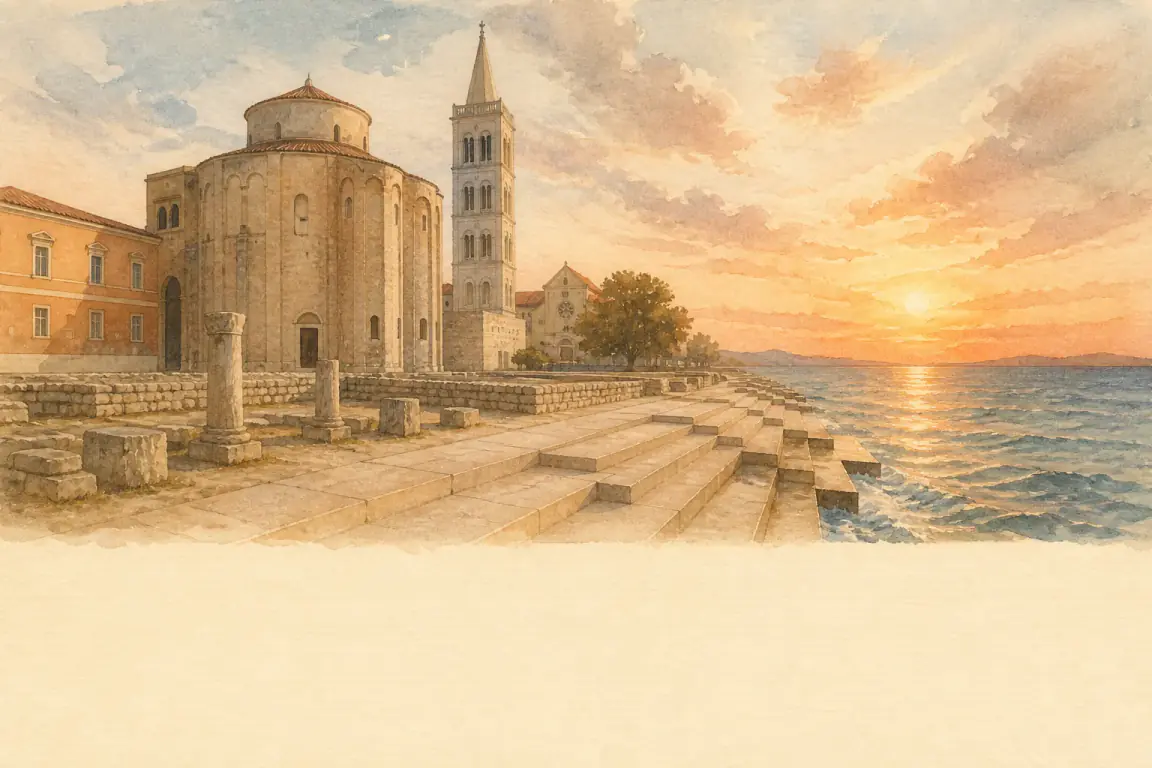
Zadar holidays
Mid-size coastal city offering workable mix of Old Town peninsula, nearby beaches and road access to national parks.
Prices on this page are shown from the UK. Change market
25°C SeptemberBest Jun, Jul, Aug, Sep3–6 nights
At a glance
- families wanting beach plus town
- road trips to national parks
- medium-length coastal stays
Trip cost
- Return flight
- ≈€233
- Stay
- ≈€220
- Food & local
- ≈€48
Includes the return fare from London Stansted. An estimate, not a quote — each booking happens separately with its supplier. How we work this out.
Prices shown on this page are indicative estimates in euros, not quotes. Every booking happens separately with its own supplier, at that supplier's own live price. How we work this out.
Stays
Stays in Zadar
Typically around €64/night, a Croatia-wide estimate · €110 mid-range — not a live listing price
Map
Review or change this anytime on our privacy page.
Self-catering
Prefer a place of your own? Browse holiday homes and apartments in Zadar on Holidu.
Getting to Zadar
- AirportZadar Airport (ZAD)
- Transfer optionsBus, taxi
Zadar Airport sits about 8 kilometres from the city with dedicated buses linking the terminal to the Old Town and main bus station, plus taxis.
Indicative, per traveller. You book with Aviasales.
Areas of Zadar
A few places people base themselves, and who each tends to suit.
- Old Town (Poluotok)Best for first-time visitors who want historic streets and seafront promenades within a compact, mostly pedestrian zone.
- BorikSuited to families wanting child-friendly beaches and accommodation while remaining a short journey from the Old Town.
- DikloGood for budget-conscious travellers seeking a quieter, more residential seaside area north-west of the centre.
- ArbanasiAppeals to couples and visitors wanting a calmer neighbourhood with easy access to beaches and a short hop to the peninsula.
- KolovarePractical for travellers who want a main city beach and nightlife while staying close to central streets.
Zadar weather by month
Zadar is warmest in July, when daily highs average 30°C, and coolest in January at 11°C. November is the wettest month at about 187 mm, June the driest at 40 mm. Taking warmth and rainfall together, June, July, August, September score best for a trip.
- Best overall
- June · July · August · September
- Hottest
- July · 30°C
- Wettest
- November · 187mm
- January: average daily high 11°C, 121mm rainfall.
- February: average daily high 12°C, 88mm rainfall.
- March: average daily high 14°C, 111mm rainfall.
- April: average daily high 17°C, 80mm rainfall.
- May: average daily high 22°C, 105mm rainfall.
- June: average daily high 27°C, 40mm rainfall. Good month for weather.
- July: average daily high 30°C, 44mm rainfall. Good month for weather.
- August: average daily high 30°C, 81mm rainfall. Good month for weather.
- September: average daily high 25°C, 139mm rainfall. Good month for weather.
- October: average daily high 21°C, 119mm rainfall.
- November: average daily high 16°C, 187mm rainfall.
- December: average daily high 13°C, 167mm rainfall.
How these figures are worked out
Monthly averages — multi-year historical data, not a standard 30-year climate normal or a forecast. Gold months are the best weather fit: each month scores on how close its average daily high sits to about 27 °C, with heavy rainfall counting against it, and months far outside that range are not ranked at all.
What each season is like
- Spring
- Pleasant for mixing town walks with early-season beach visits; some beach services and boat trips may still be limited.
- Summer
- Beach areas and Old Town bars become busy and weekend noise can carry, especially near central streets.
- Autumn
- Sea remains usable for a while and crowds ease, though some beachfront facilities and seasonal services scale back.
- Winter
- City continues functioning but beach and island options are reduced, making Zadar more of a local centre than a seaside holiday base.
What’s on in Zadar
Compare Croatia destinations
Still deciding? Other Croatia destinations, with the same weather and typical-stay data behind them.
More from the UK
Good to know about Zadar
Why go
- Better suited than Split or Dubrovnik as a base for combining coastal days with Kornati and inland national parks by road.
- Offers family-friendly beach neighbourhoods like Borik and Diklo within reach of the Old Town, which Zagreb lacks.
- Feels less dominated by cruise ships and large resorts than Dubrovnik or some Istrian peninsulas.
Worth knowing
- Old Town can be noisy at weekends and in summer, which may not suit light sleepers.
- Public transport to some beaches and outlying areas is limited, so families may prefer having a car.
- Seasonal focus means some beach bars and facilities close or reduce hours outside peak summer.