Oslo holidays
A fjord-side Nordic capital that mixes modern waterfront architecture with forest and ski trails at the edge of the city.
Prices on this page are shown from the UK. Change market
16°C SeptemberBest May, Jun, Jul, Aug2–4 nightsRecent nonstop return fare from London Heathrow
At a glance
- short city breaks
- combining a city stay with a day in the forest or hills
- design and architecture
Trip cost
- Return flight
- ≈€119
- Stay
- ≈€588
- Food & local
- ≈€161
Includes the return fare from London Heathrow. An estimate, not a quote — each booking happens separately with its supplier. How we work this out.
Prices shown on this page are indicative estimates in euros, not quotes. Every booking happens separately with its own supplier, at that supplier's own live price. How we work this out.
Stays
Stays in Oslo
From €66/night · Typical €176 · 113 stays · 4-night stay assumed

- Best 3-starTranquility near everything - Majorstua2.4 km from the centre€148 a night (opens in a new tab)
See more 3-star options
- Best 4-starPanoramic Oslofjord Views with Private Beach HutNesoddtangen Norway · 8.7 km from the centre€281 a night (opens in a new tab)
See more 4-star options
- CheapestPrivate room - 5 in a luxury villa CHALET STYLE5.0 km from the centre€66 a night (opens in a new tab)
See more options, cheapest first


Map
Review or change this anytime on our privacy page.
Self-catering
Prefer a place of your own? Browse holiday homes and apartments in Oslo on Holidu.
Getting to Oslo
- AirportOslo Airport Gardermoen (OSL)
- Transfer optionsTrain, bus, taxi
An express train reaches Oslo Central Station in around 19 minutes; buses and taxis also connect the airport to the centre.
Indicative, per traveller. You book with Aviasales.
Areas of Oslo
A few places people base themselves, and who each tends to suit.
- Sentrum (city centre)Best for first-time visitors who want the palace, main street and central station within walking distance.
- GrünerløkkaA former working-class district now known for cafes and independent shops, suited to travellers who want a livelier, younger base.
- FrognerAn upscale, leafy district around Frogner Park, suited to travellers who prefer a quieter, more residential stay close to green space.
- Aker Brygge / TjuvholmenThe rebuilt waterfront district, suited to travellers who want modern restaurants and harbour views within walking distance of the centre.
- MajorstuenA practical residential and shopping area near a main transport interchange, suited to travellers prioritising transport links over atmosphere.
Oslo weather by month
Oslo is warmest in June, when daily highs average 21°C, and coolest in December at -1°C. July is the wettest month at about 143 mm, March the driest at 54 mm. Taking warmth and rainfall together, May, June, July, August score best for a trip.
- Best overall
- May · June · July · August
- Hottest
- June · 21°C
- Wettest
- July · 143mm
- January: average daily high -1°C, 75mm rainfall.
- February: average daily high 2°C, 68mm rainfall.
- March: average daily high 5°C, 54mm rainfall.
- April: average daily high 10°C, 68mm rainfall.
- May: average daily high 17°C, 59mm rainfall. Good month for weather.
- June: average daily high 21°C, 100mm rainfall. Good month for weather.
- July: average daily high 20°C, 143mm rainfall. Good month for weather.
- August: average daily high 20°C, 129mm rainfall. Good month for weather.
- September: average daily high 16°C, 96mm rainfall.
- October: average daily high 10°C, 59mm rainfall.
- November: average daily high 4°C, 67mm rainfall.
- December: average daily high -1°C, 59mm rainfall.
How these figures are worked out
Monthly averages — ERA5 reanalysis, 2022–2024, a three-year average, not a standard 30-year climate normal or a forecast. Gold months are the best weather fit: each month scores on how close its average daily high sits to about 27 °C, with heavy rainfall counting against it, and months far outside that range are not ranked at all.
What each season is like
- Spring
- Snow clears and daylight lengthens fast, though the forest trails can stay muddy after the thaw before summer sets in.
- Summer
- Long daylight, often close to round-the-clock light in June, makes this the easiest season for the forest and fjord side of the city.
- Autumn
- Daylight shortens quickly and the forest trails turn colour before the first snow, typically later in the season.
- Winter
- Daylight shrinks to only a few hours around the solstice, one of the shortest winters of any European capital, but snow turns the city's forest trails into cross-country ski routes, so the outdoor habit continues through winter rather than moving indoors.
What’s on in Oslo
Our sister site Wanderistan tracks what's on in Oslo — gigs, festivals and tickets.
Nearby and alternative destinations
Nearby — reachable overland
- Stockholm~416km straight-line
Also consider
More from the UK
Good to know about Oslo
Why go
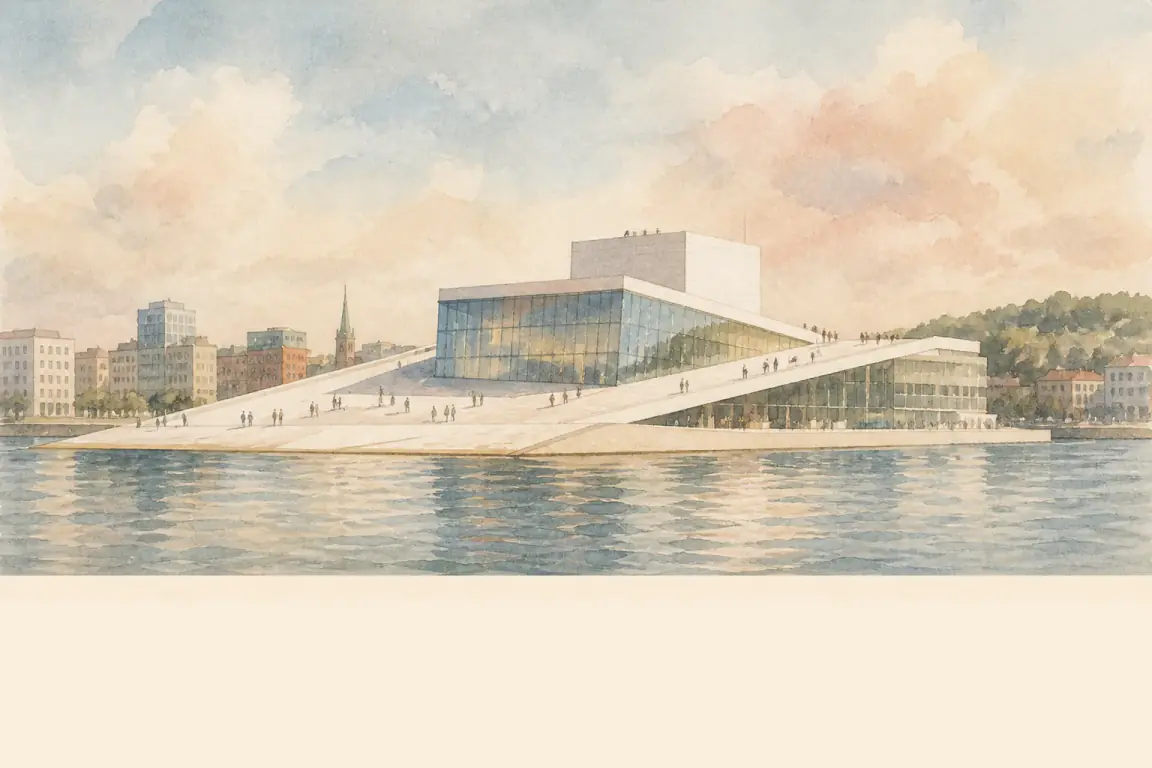
- The waterfront around the opera house and Aker Brygge has been rebuilt over the last two decades, giving the centre a modern, walkable harbour front.
- Forest and marked trails, used for cross-country skiing in winter, begin at the edge of the city and are reachable from the centre without needing a car.
- Museums covering Viking ships, polar exploration and modern art sit close together on the Bygdøy peninsula, a short ferry or bus ride from the centre.
Worth knowing
- The city is spread along the fjord rather than built around one dense core, so reaching the forest trails or Bygdøy's museums takes planning rather than just walking from a central hotel.
- Winter daylight is short, down to only a few hours around the solstice, which limits sightseeing time regardless of how the trip is planned.
- The centre itself is compact, so a stay longer than three or four nights needs the forest, fjord islands or Bygdøy to stay interesting.