Kotor holidays
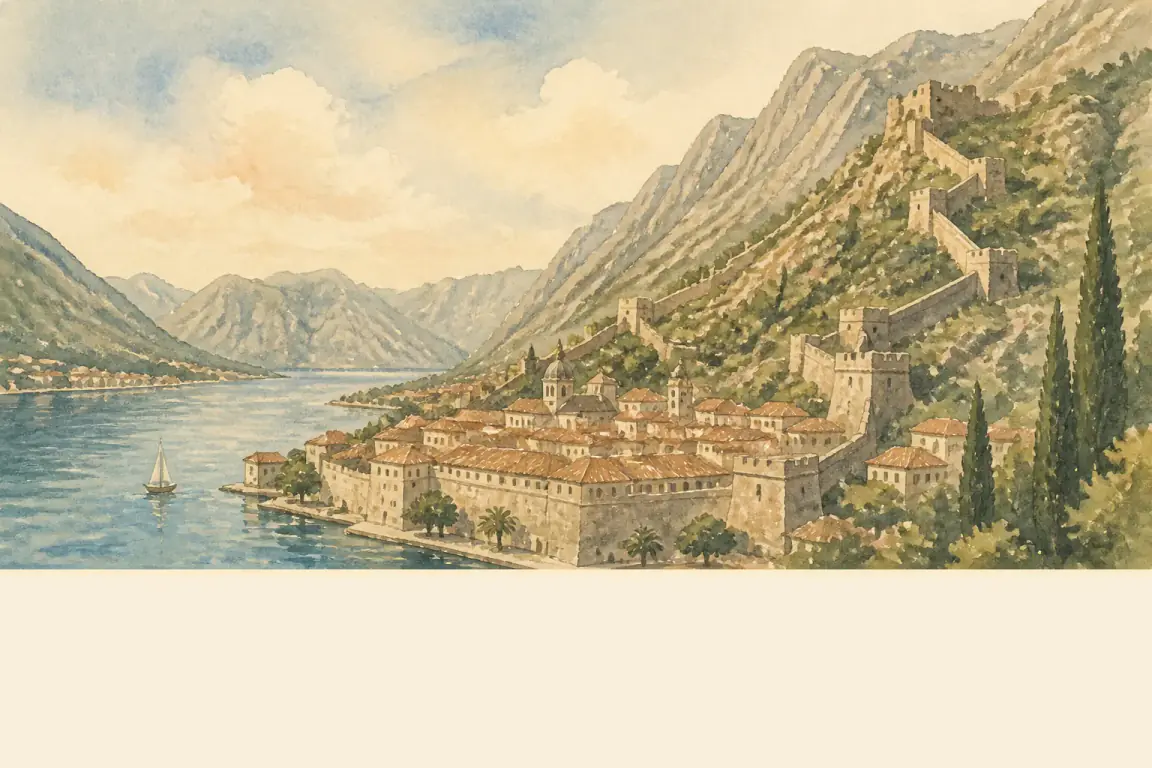
A walled old town on a dramatic bay where limestone mountains drop straight into the Adriatic.
Prices on this page are shown from the UK. Change market
25°C SeptemberBest Jun, Jul, Aug, Sep2–3 nightsRecent nonstop return fare from London Stansted
At a glance
- coastal scenery
- walkable old towns
- Adriatic coast touring
Trip cost
- Return flight
- ≈€152
- Stay
- ≈€504
- Food & local
- ≈€140
Includes the return fare from London Stansted. An estimate, not a quote — each booking happens separately with its supplier. How we work this out.
Prices shown on this page are indicative estimates in euros, not quotes. Every booking happens separately with its own supplier, at that supplier's own live price. How we work this out.
Stays
Stays in Kotor
From €47/night · Typical €77 · 109 stays · for your 7 nights

- Best 3-starApartment Brijest-Kotor4.8 km from the centre€52 a night (opens in a new tab)
See more 3-star options
- Best 4-starTeuta Apartment in TivatŽupa Montenegro · 5.0 km from the centre€67 a night (opens in a new tab)
See more 4-star options
- CheapestApartman StrahinjaTivat Montenegro · 4.3 km from the centre€47 a night (opens in a new tab)
See more options, cheapest first


Map
Review or change this anytime on our privacy page.
Self-catering
Prefer a place of your own? Browse holiday homes and apartments in Kotor on Holidu.
Getting to Kotor
- AirportTivat Airport (TIV)
- Transfer optionsTaxi
Kotor has no airport of its own. Tivat Airport, on the other side of the bay, is 8 km from Kotor — about 12 minutes by road. Taxis and hire cars cover the route. Podgorica and Dubrovnik are the fallbacks when Tivat has no suitable direct flight, and both are noticeably longer drives. Note that the Kamenari–Lepetane car ferry across the narrow strait, often suggested as a shortcut, does not shorten the drive to Kotor itself, which already sits on the direct road round the bay; it can also queue at busy summer times.
These fares are not for your selected dates.
Indicative, per traveller. You book with Aviasales.
Areas of Kotor
A few places people base themselves, and who each tends to suit.
- Kotor Old Town (Stari Grad)Best for first-time visitors who want the walls, the cathedral and the fortress trail within immediate walking distance, at the cost of being the busiest point on the bay.
- DobrotaSuited to travellers wanting a quieter waterfront base with baroque villas, a short walk or drive from the old town.
- MuoA quiet, practical choice for a longer stay along the bay, with easy access back into Kotor without the old town's crowds.
- PerastGood for travellers prioritising bay views and a slower pace over nightlife, further round the water and best suited to those with a car.
Kotor weather by month
Kotor is warmest in July, when daily highs average 31°C, and coolest in January at 12°C. November is the wettest month at about 378 mm, July the driest at 31 mm. Taking warmth and rainfall together, June, July, August, September score best for a trip.
- Best overall
- June · July · August · September
- Hottest
- July · 31°C
- Wettest
- November · 378mm
- January: average daily high 12°C, 253mm rainfall.
- February: average daily high 13°C, 185mm rainfall.
- March: average daily high 14°C, 182mm rainfall.
- April: average daily high 17°C, 190mm rainfall.
- May: average daily high 22°C, 181mm rainfall.
- June: average daily high 27°C, 107mm rainfall. Good month for weather.
- July: average daily high 31°C, 31mm rainfall. Good month for weather.
- August: average daily high 30°C, 76mm rainfall. Good month for weather.
- September: average daily high 25°C, 225mm rainfall. Good month for weather.
- October: average daily high 22°C, 203mm rainfall.
- November: average daily high 17°C, 378mm rainfall.
- December: average daily high 14°C, 254mm rainfall.
How these figures are worked out
Monthly averages — ERA5 reanalysis, 2022–2024, a three-year average, not a standard 30-year climate normal or a forecast. Gold months are the best weather fit: each month scores on how close its average daily high sits to about 27 °C, with heavy rainfall counting against it, and months far outside that range are not ranked at all.
What each season is like
- Spring
- March to May warms from around 11°C to 19°C, though rainfall stays fairly heavy right through the season — green hillsides and fewer visitors before the cruise season builds, but pack for rain.
- Summer
- June to August is hot, peaking around 27°C in July, and by far the driest run of the year — July averages just 31mm of rain, though June and August still see real showers. This is also the peak cruise-ship season, with the old town most crowded around midday.
- Autumn
- September to November cools from around 22°C to 14°C while rainfall rises sharply — November averages close to 380mm — so this thinner-crowds season comes with a real chance of heavy rain.
- Winter
- December to February is mild by northern European standards, averaging 9–11°C, but wet: many bay-side restaurants and boat trips reduce their hours or close, and this is one of the rainiest stretches of the year.
Nearby and alternative destinations
Nearby — reachable overland
- Dubrovnik~61km straight-lineborder crossing, often slow in midsummer
Also consider
More from the UK
Good to know about Kotor
Why go
- The old town's walls and lanes sit directly on the water, with the fortress trail climbing straight up behind them.
- The Bay of Kotor's mountain-and-water scenery is dramatic without a long drive to reach it.
- Kotor's old town and bay are recognised as part of Montenegro's UNESCO World Heritage cultural sites, reflecting centuries as a fortified Adriatic trading harbour.
- Nearby bay villages like Perast make easy, low-key half-day trips.
Worth knowing
- The old town is small enough to see fully in a day, so a longer stay needs day trips along the bay or into the mountains behind it.
- Cruise ships call regularly and can fill the old town's lanes and main square for several hours at a time.
- The climb to the fortress above the town is steep, uneven and largely unshaded.
- Kotor's autumn and winter months are genuinely wet — November alone averages close to 380mm of rain, so late-year trips carry a real chance of washed-out plans.
- The road around the inner bay winds into every inlet, so driving times run well beyond what the straight-line distance suggests — worth allowing for when planning a day out to Perast or further round the coast.
Official references
Authoritative pages worth checking before you go to Kotor.
- Natural and Culturo-Historical Region of Kotor on the UNESCO World Heritage list (opens in a new tab) — UNESCO World Heritage Centre
- Kamenari–Lepetane car ferry timetable and information (opens in a new tab) — JPMD, the ferry operator
- Tivat Airport: how to reach it (opens in a new tab) — Airports of Montenegro