Polis breaks
Small town hub on Chrysochous Bay, about 35km northwest of Paphos, combining simple beachfront, camping and everyday services close to nearby villages.
30°C SeptemberBest May, Jun, Sep, Oct3–7 nights
At a glance
- camping and caravans
- quiet coastal stays
- self-drive holidays
Trip cost
- Stay
- ≈€512
- Food & local
- ≈€120
An estimate, not a quote — each booking happens separately with its supplier. How we work this out.
Prices shown on this page are indicative estimates in euros, not quotes. Every booking happens separately with its own supplier, at that supplier's own live price. How we work this out.
Stays
Stays in Polis
From €45/night · Typical €95 · 86 stays · 4-night stay assumed

- Best 3-starSilver View Apartment466 m from the centre€73 a night (opens in a new tab)
See more 3-star options
- Best 4-starHarma Traditional Boutique SuitesPaphos City CY · 5.9 km from the centre€181 a night (opens in a new tab)
See more 4-star options
- CheapestNicos & Olympia Apartments210 m from the centre€45 a night (opens in a new tab)
See more options, cheapest first


Map
Review or change this anytime on our privacy page.
Getting to Polis
- Drive from Paphosabout 45 min
- Distance≈45 km by road
- Getting aroundWalkable centre
- Nearest airportPFO
- Transfer optionsBus, taxi
Distance is straight-line from Paphos with a road allowance added; the drive time is approximate and assumes ordinary conditions. Neither comes from a routing service.
Paphos International Airport is the nearest airport. Taxi is the most direct option; bus services also run via Paphos town.
Areas of Polis
A few places people base themselves, and who each tends to suit.
- Polis town centreBest for visitors wanting walkable access to shops and simple dining while still near the bay.
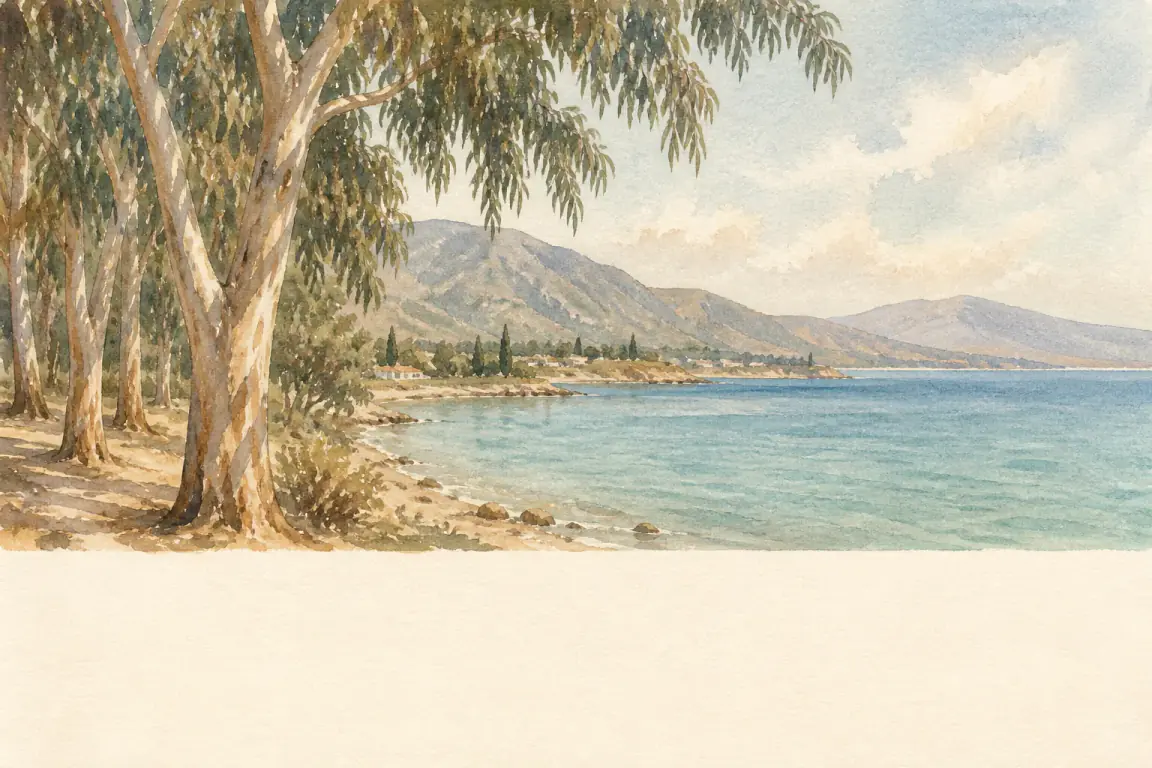
- Polis campsite and eucalyptus beachSuited to campers and those preferring a basic beach environment backing onto trees and coastal walkway.
- Coastal walkway towards LatchiAppeals to travellers who enjoy staying in town but walking or cycling along the coast to the harbour.
- Polis outskirts towards rural villagesBetter for those wanting simple accommodation among fields and villages, still within short driving distance of the bay.
Polis weather by month
Polis is warmest in July, when daily highs average 34°C, and coolest in February at 17°C. January is the wettest month at about 106 mm, July the driest at 0 mm. Taking warmth and rainfall together, May, June, September, October score best for a trip.
- Best overall
- May · June · September · October
- Hottest
- July · 34°C
- Wettest
- January · 106mm
- January: average daily high 17°C, 106mm rainfall.
- February: average daily high 17°C, 53mm rainfall.
- March: average daily high 18°C, 55mm rainfall.
- April: average daily high 22°C, 21mm rainfall.
- May: average daily high 25°C, 18mm rainfall. Good month for weather.
- June: average daily high 30°C, 6mm rainfall. Good month for weather.
- July: average daily high 34°C, 0mm rainfall.
- August: average daily high 32°C, 1mm rainfall.
- September: average daily high 30°C, 7mm rainfall. Good month for weather.
- October: average daily high 27°C, 24mm rainfall. Good month for weather.
- November: average daily high 23°C, 54mm rainfall.
- December: average daily high 19°C, 57mm rainfall.
How these figures are worked out
Monthly averages — ERA5 reanalysis, 2022–2024, a three-year average, not a standard 30-year climate normal or a forecast. Gold months are the best weather fit: each month scores on how close its average daily high sits to about 27 °C, with heavy rainfall counting against it, and months far outside that range are not ranked at all.
What each season is like
- Spring
- Good for walking, camping and quieter waterfront stays; some services may be limited early in the season.
- Summer
- Bay and campsite can be busy, but town remains modest in scale; heat makes midday activities more strenuous.
- Autumn
- Often calmer on the beach and in town; sea generally usable, but some seasonal operations reduce later in autumn.
- Winter
- Camping and some beach facilities may close; town remains functioning but feels more like a quiet residential centre.
Compare Cyprus destinations
Still deciding? Other Cyprus destinations, with the same weather and typical-stay data behind them.
Good to know about Polis
Why go
- Acts as the service centre for the bay, with more everyday amenities than staying only in Latchi.
- Camping area and eucalyptus-fringed beach offer a less built-up coastal base than Paphos or Limassol.
- Short distance to Latchi harbour while keeping a quieter town feel as your base.
- Latchi is Polis's own harbour — the municipality describes it that way — so staying in Polis puts the market, shops and the eucalyptus-shaded campsite on one side, with the marina, boat trips and fish tavernas a short way along the coastal walkway on the other.
- Bus route 622 ends at the Baths of Aphrodite, where the Department of Forests' circular Aphrodite and Adonis nature trails begin, so the Akamas peninsula's best-known walks are reachable without a car; the shared opening section climbs over rocky ground, so it is a proper walk rather than a stroll.
Worth knowing
- Buses cover the essentials — route 645 to Paphos through the day, with fewer departures on Saturdays, and route 622 to Latchi and the Baths of Aphrodite — but the Akamas interior and the hill villages are really car territory.
- Smaller selection of accommodation and dining than larger resorts, especially off season.
- Camping and simple beach infrastructure mean fewer polished resort-style options.
- Distance from airports is greater than in major coastal towns, stretching transfer times.
- The municipal campsite opens only from March to the end of October.
Official references
Authoritative pages worth checking before you go to Polis.
- Latchi Harbour (opens in a new tab) — Municipality of Polis Chrysochous
- Polis Chrysochous municipal camping site (opens in a new tab) — Municipality of Polis Chrysochous
- Pafos Bus Service Polis and Latchi routes, including 645 and 622 (opens in a new tab) — Pafos Bus Service (OSYPA)