Brussels holidays
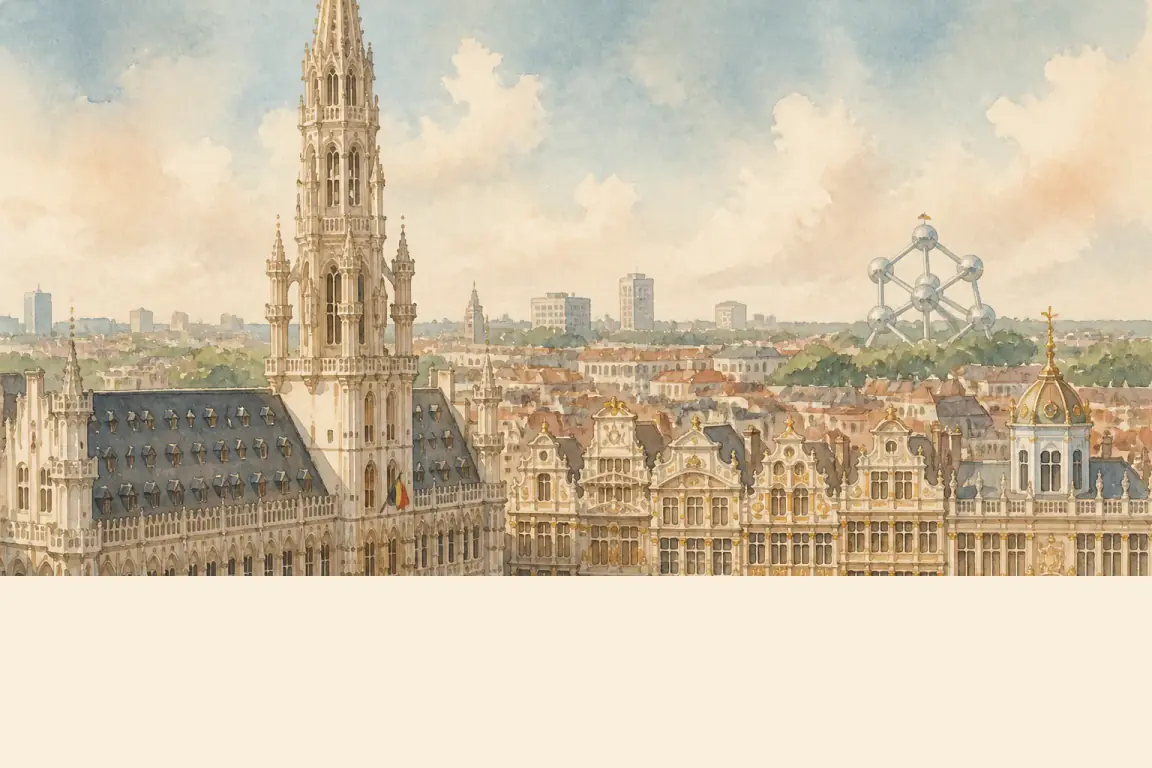
A compact, well-connected capital built around one of Europe's grand historic squares, with a food and beer culture that outperforms the city's size.
Prices on this page are shown from the UK. Change market
17°C OctoberBest Jun, Jul, Aug, Sep2–3 nights
At a glance
- food and beer culture
- short city breaks
- rail-linked multi-city trips
Trip cost
- Return flight
- ≈€119
- Stay
- ≈€564
- Food & local
- ≈€160
Includes the return fare from London Stansted. An estimate, not a quote — each booking happens separately with its supplier. How we work this out.
Prices shown on this page are indicative estimates in euros, not quotes. Every booking happens separately with its own supplier, at that supplier's own live price. How we work this out.
Stays
Stays in Brussels
From €69/night · Typical €152 · 217 stays · 4-night stay assumed

- Best 3-starAtomium Apartment 14.9 km from the centre€148 a night (opens in a new tab)
See more 3-star options
- Best 4-starMagnifique appartement- Brussels expo Laeken5.6 km from the centre€168 a night (opens in a new tab)
See more 4-star options
- CheapestSleep & Go Brussels Expo Hotel6.2 km from the centre€69 a night (opens in a new tab)
See more options, cheapest first


Map
Review or change this anytime on our privacy page.
Self-catering
Prefer a place of your own? Browse holiday homes and apartments in Brussels on Holidu.
Getting to Brussels
- AirportBrussels Airport (BRU)
- Transfer optionsTrain, bus, taxi
Brussels Airport reaches the city centre in about 20 minutes. The Airport Line bus runs directly to the centre, connecting to the metro at Schuman and Trône; trains and taxis also serve the airport.
Indicative, per traveller. You book with Aviasales.
Areas of Brussels
A few places people base themselves, and who each tends to suit.
- Grand-Place / Îlot SacréBest for first-time visitors who want to be inside the historic core, steps from the main square, and accept the crowds that come with it.
- SablonSuited to travellers who want antique shops, chocolatiers and a quieter, more refined pace than the Grand-Place area.
- Sainte-Catherine / Saint-GéryGood for visitors prioritising food and nightlife, with converted market halls and a dense cluster of restaurants and bars.
- IxellesWorks for a longer stay, with a more residential feel and dining that reaches well beyond Belgian classics.
- MarollesA practical choice for travellers interested in the flea market and antique trade, with a plainer, more working-class character than the centre.
Brussels weather by month
Brussels is warmest in August, when daily highs average 24°C, and coolest in January at 6°C. September is the wettest month at about 94 mm, August the driest at 48 mm. Taking warmth and rainfall together, June, July, August, September score best for a trip.
- Best overall
- June · July · August · September
- Hottest
- August · 24°C
- Wettest
- September · 94mm
- January: average daily high 6°C, 65mm rainfall.
- February: average daily high 10°C, 67mm rainfall.
- March: average daily high 12°C, 78mm rainfall.
- April: average daily high 14°C, 68mm rainfall.
- May: average daily high 19°C, 72mm rainfall.
- June: average daily high 22°C, 73mm rainfall. Good month for weather.
- July: average daily high 23°C, 71mm rainfall. Good month for weather.
- August: average daily high 24°C, 48mm rainfall. Good month for weather.
- September: average daily high 21°C, 94mm rainfall. Good month for weather.
- October: average daily high 17°C, 80mm rainfall.
- November: average daily high 11°C, 88mm rainfall.
- December: average daily high 7°C, 81mm rainfall.
How these figures are worked out
Monthly averages — ERA5 reanalysis, 2022–2024, a three-year average, not a standard 30-year climate normal or a forecast. Gold months are the best weather fit: each month scores on how close its average daily high sits to about 27 °C, with heavy rainfall counting against it, and months far outside that range are not ranked at all.
What each season is like
- Spring
- Mild with lengthening days, though rain is frequent; a comfortable season for walking without summer crowds.
- Summer
- The warmest, driest months, with outdoor terraces and festivals filling the centre, though sun is still never guaranteed.
- Autumn
- Cooler and wetter, with fewer visitors and good conditions for museums and long meals indoors.
- Winter
- Cold, dark early and often damp, but the Christmas market around the Grand-Place is a genuine seasonal draw.
What’s on in Brussels


See all events in Brussels on Wanderistan (opens in a new tab)
Nearby and alternative destinations
More from the UK
Good to know about Brussels
Why go
- The Grand-Place is one of Europe's great historic squares, and the surrounding lanes hold it at street level rather than behind a fence.
- A food and drink culture — beer, chocolate and a serious restaurant scene — that outperforms the city's size.
- Central rail links make Brussels an easy base for side trips elsewhere in Belgium.
Worth knowing
- Weather is unreliable across the year, and frequent rain and grey skies can flatten a short visit regardless of season.
- The historic centre is compact and can feel overwhelmed by tour groups around the Grand-Place in peak season.
- Brussels' charm concentrates in a few central pockets — some surrounding districts are plain, administrative areas built for the EU institutions rather than visitors.