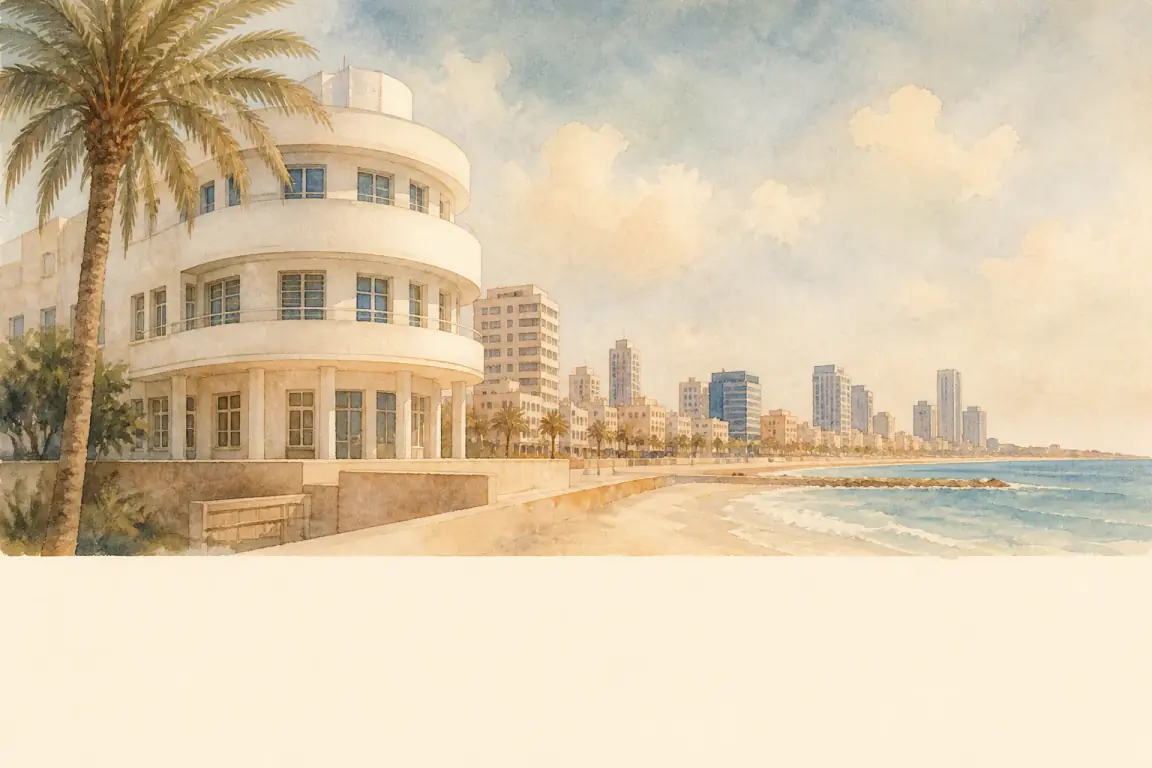
Tel Aviv holidays
Mediterranean beach city break where you split time between long urban beaches, Bauhaus streets and late-night food and bars.
Prices on this page are shown from the UK. Change market
31°C SeptemberBest May, Jun, Sep, Oct4–7 nights
At a glance
- beach-plus-city trips
- nightlife-oriented stays
- food-focused visitors
- shoulder-season sun
Trip cost
- Return flight
- ≈€203
- Stay
- ≈€392
- Food & local
- ≈€94
Includes the return fare from London Gatwick. An estimate, not a quote — each booking happens separately with its supplier. How we work this out.
Prices shown on this page are indicative estimates in euros, not quotes. Every booking happens separately with its own supplier, at that supplier's own live price. How we work this out.
Stays
Stays in Tel Aviv
From €43/night · Typical €239 · 133 stays · for your 2 nights

- Best 3-starRokah Luxury Villa5.1 km from the centre€130 a night (opens in a new tab)
See more 3-star options
- Best 4-starMaster Shenkin2.0 km from the centre€213 a night (opens in a new tab)
See more 4-star options
- Best 5-starR48 Hotel And Garden2.5 km from the centre€1009 a night (opens in a new tab)
See more 5-star options
- Cheapestדניאל לוי4.1 km from the centre€43 a night (opens in a new tab)
See more options, cheapest first


Map
Review or change this anytime on our privacy page.
Self-catering
Prefer a place of your own? Browse holiday homes and apartments in Tel Aviv on Holidu.
Getting to Tel Aviv
- AirportBen Gurion Airport (TLV)
- Transfer optionsTrain, bus, taxi
Ben Gurion Airport is about 15 km from Tel Aviv. A direct Israel Railways train runs from the airport's own station into the city, and Kavim's bus 445 runs from Terminal 3 to central streets such as Dizengoff and Ben Yehuda; neither runs during Shabbat, from Friday evening to Saturday evening, so check the operators' timetables for late or weekend arrivals. Taxis run at all times.
These fares are not for your selected dates.
Indicative, per traveller. You book with Aviasales.
Areas of Tel Aviv
A few places people base themselves, and who each tends to suit.
- Neve TzedekOldest district, now a trendy and pricier neighbourhood with village-like streets, suited to design-conscious visitors who don't mind paying more to stay central.
- FlorentinGraffiti-marked area with bars and a younger feel, good for travellers wanting to be close to nightlife and creative spaces rather than the beachfront.
- JaffaHistoric port area with older stone streets and harbour views, suits those wanting a more traditional setting while still near beaches, a short ride or long walk from the main strip.
- Yemenite Quarter (Kerem HaTeimanim)Small district near Carmel Market offering a village atmosphere close to central beaches, suited to visitors who want quiet streets without giving up a central base.
- Beachfront around Gordon and FrishmanHotel-lined seafront ideal for classic beach-plus-promenade stays with easy access to sand and the Tayelet, at the cost of being the busiest and priciest strip in summer.
Tel Aviv weather by month
Tel Aviv is warmest in August, when daily highs average 32°C, and coolest in February at 18°C. January is the wettest month at about 159 mm, July the driest at 2 mm. Taking warmth and rainfall together, May, June, September, October score best for a trip.
- Best overall
- May · June · September · October
- Hottest
- August · 32°C
- Wettest
- January · 159mm
- January: average daily high 18°C, 159mm rainfall.
- February: average daily high 18°C, 88mm rainfall.
- March: average daily high 20°C, 74mm rainfall.
- April: average daily high 24°C, 42mm rainfall.
- May: average daily high 26°C, 5mm rainfall. Good month for weather.
- June: average daily high 30°C, 3mm rainfall. Good month for weather.
- July: average daily high 31°C, 2mm rainfall.
- August: average daily high 32°C, 2mm rainfall.
- September: average daily high 31°C, 3mm rainfall. Good month for weather.
- October: average daily high 28°C, 10mm rainfall. Good month for weather.
- November: average daily high 24°C, 66mm rainfall.
- December: average daily high 21°C, 87mm rainfall.
How these figures are worked out
Monthly averages — ERA5 reanalysis, 2022–2024, a three-year average, not a standard 30-year climate normal or a forecast. Gold months are the best weather fit: each month scores on how close its average daily high sits to about 27 °C, with heavy rainfall counting against it, and months far outside that range are not ranked at all.
What each season is like
- Spring
- Pleasant for combining beach walks and city exploring, with April and May warming from a 19C to 22C average and rainfall dropping away fast; some religious holidays affect opening patterns and crowd levels.
- Summer
- Hot and busy on the seafront -- June to August average highs of 30-32C with almost no rain -- and late-night activity and beach clubs create noise; good for sea swimming but harder for midday city walks.
- Autumn
- Often comfortable, with September still averaging a 31C high and warm sea temperatures alongside slightly fewer domestic holiday-makers; occasional autumn storms can affect beach days as the season turns.
- Winter
- Milder than many European cities -- December to February average highs stay in the 17-21C range -- and good for urban breaks, but this is also the wettest stretch of the year and not a consistent beach-swimming season.
More from the UK
Good to know about Tel Aviv
Why go
- Combines extensive city beaches with an urban core in a way nearby destinations like Jerusalem do not.
- Nightlife runs much later and denser than many other regional cities, shaping evening-focused itineraries.
- Neighbourhoods like Neve Tzedek and Florentin offer distinct atmospheres compared with the old port of Jaffa.
- Flights here run longer than most European city breaks on this site, which is worth weighing against the shorter nights this trip usually needs.
- Shabbat reshapes the weekend: buses and the light rail stop from Friday afternoon until after dark on Saturday, and most shops shut, though many bars, cafes and beachfront restaurants stay open. A free municipal weekend bus network runs Friday evening and Saturday daytime, and shared sherut taxis keep going throughout, so a Friday arrival or a Saturday-heavy trip is workable — but it needs planning rather than an assumption that normal city transport applies.
- Jerusalem is close enough to visit for the day by direct train or coach, which makes it a common add-on without moving hotel; that service also pauses for Shabbat. Jaffa, by contrast, is a walk down the promenade from the centre rather than a day trip.
- The White City — more than four thousand 1930s buildings in the International Style — is a UNESCO World Heritage Site, which is what gives the Bauhaus streets their status rather than just their look.
Worth knowing
- City can feel intense and noisy, especially around nightlife and main roads.
- Costs for accommodation and dining are relatively high compared with many Mediterranean cities.
- UK travellers now need an Electronic Travel Authorisation (ETA) before flying, introduced in January 2025 -- it costs 25 shekels, covers a 90-day visit and stays valid for two years, applied for online in advance rather than on arrival.
Source: UK Foreign, Commonwealth & Development Office (gov.uk) (opens in a new tab), checked
- The UK government currently advises against all but essential travel to parts of Israel, and against all travel to Gaza and areas near its border; Tel Aviv itself is not in the strictest zone, but the wider regional situation and possible airspace disruption are worth checking on gov.uk close to your travel dates, not just when booking.
Source: UK Foreign, Commonwealth & Development Office (gov.uk) (opens in a new tab), checked
Official references
Authoritative pages worth checking before you go to Tel Aviv.
- Naim Besofash free weekend bus network for the Tel Aviv area (opens in a new tab) — Naim Besofash (Gush Dan municipal weekend transport)
- Israel Railways timetables, including the Jerusalem and airport lines (opens in a new tab) — Israel Railways