Dublin holidays
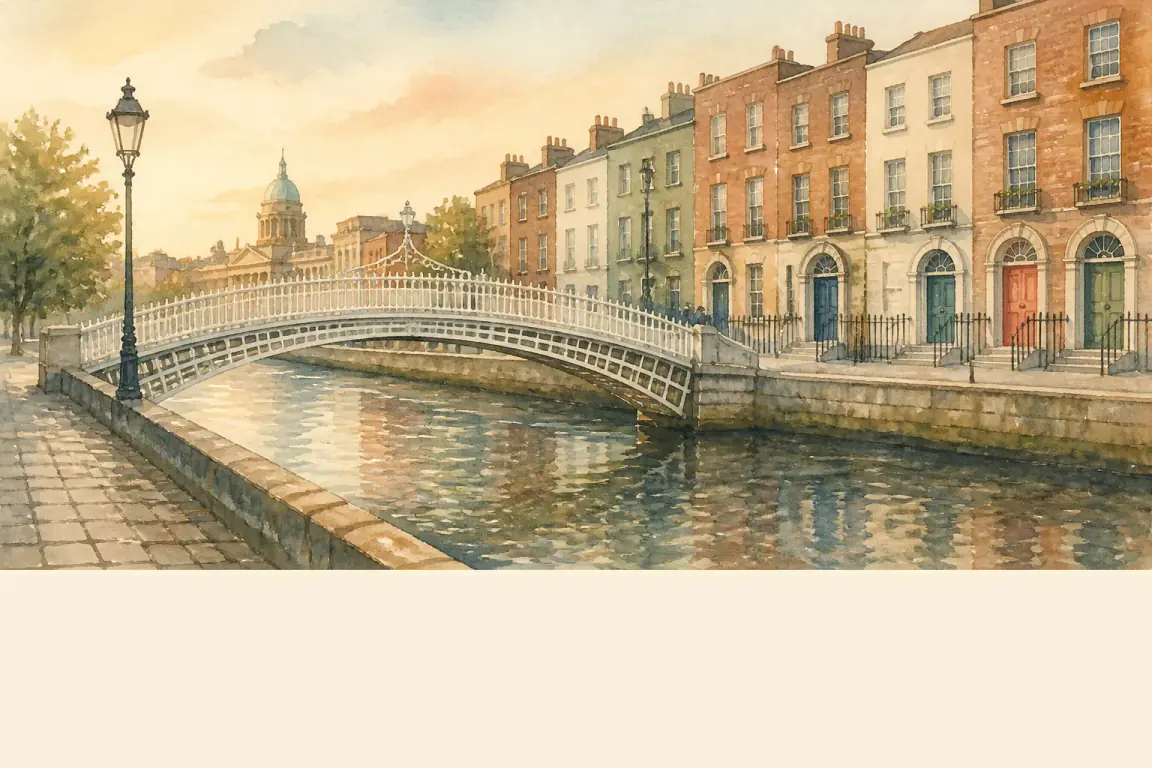
Ireland's capital, a compact, riverside city built around Georgian squares and a pub culture that is a genuine social institution, with the coast and hills close by.
Prices on this page are shown from the UK. Change market
17°C SeptemberBest Jun, Jul, Aug, Sep2–4 nightsRecent nonstop return fare from Manchester
At a glance
- short city breaks
- weekend trips
- combining with a coastal or Wicklow day trip
Trip cost
- Return flight
- ≈€40
- Stay
- ≈€540
- Food & local
- ≈€160
Includes the return fare from Manchester. An estimate, not a quote — each booking happens separately with its supplier. How we work this out.
Prices shown on this page are indicative estimates in euros, not quotes. Every booking happens separately with its own supplier, at that supplier's own live price. How we work this out.
Stays
Stays in Dublin
From €114/night · Typical €178 · 109 stays · 4-night stay assumed

- Best 3-starKenilworth Square North3.6 km from the centre€900 a night (opens in a new tab)
See more 3-star options
- Best 4-starHaddington House10.7 km from the centre€321 a night (opens in a new tab)
See more 4-star options
- Best 5-starRadisson Blu St. Helen's Hotel6.3 km from the centre€166 a night (opens in a new tab)
See more 5-star options
- CheapestMulgrave LodgeCo Dublin 47 Mulgrave Street · 10.5 km from the centre€114 a night (opens in a new tab)
See more options, cheapest first


Map
Review or change this anytime on our privacy page.
Self-catering
Prefer a place of your own? Browse holiday homes and apartments in Dublin on Holidu.
Getting to Dublin
- AirportDublin Airport (DUB)
- Transfer optionsBus, taxi
Buses and taxis run from Dublin Airport to the city centre.
We haven’t found enough fresh fares for these dates yet.
Check flights on Aviasales (opens in a new tab)Areas of Dublin
A few places people base themselves, and who each tends to suit.
- Temple BarThe city's best-known nightlife district, suited to travellers who want to be in the middle of the noise, though it is louder and busier than the rest of the centre.
- Georgian core (St Stephen's Green / Grafton Street)Best for first-time visitors who want the main shopping street, parks and sights within walking distance.
- DocklandsA modern, riverside business district, suited to travellers who prefer newer hotels and quieter evenings over being in the historic core.
- Rathmines / PortobelloA more residential, canal-side area a short walk or bus ride from the centre, suited to travellers who want a local feel over a tourist one.
Dublin weather by month
Dublin is warmest in August, when daily highs average 20°C, and coolest in January at 9°C. October is the wettest month at about 116 mm, January the driest at 48 mm. Taking warmth and rainfall together, June, July, August, September score best for a trip.
- Best overall
- June · July · August · September
- Hottest
- August · 20°C
- Wettest
- October · 116mm
- January: average daily high 9°C, 48mm rainfall.
- February: average daily high 10°C, 62mm rainfall.
- March: average daily high 11°C, 111mm rainfall.
- April: average daily high 12°C, 81mm rainfall.
- May: average daily high 16°C, 58mm rainfall.
- June: average daily high 18°C, 72mm rainfall. Good month for weather.
- July: average daily high 19°C, 92mm rainfall. Good month for weather.
- August: average daily high 20°C, 83mm rainfall. Good month for weather.
- September: average daily high 17°C, 113mm rainfall. Good month for weather.
- October: average daily high 15°C, 116mm rainfall.
- November: average daily high 11°C, 81mm rainfall.
- December: average daily high 9°C, 78mm rainfall.
How these figures are worked out
Monthly averages — ERA5 reanalysis, 2022–2024, a three-year average, not a standard 30-year climate normal or a forecast. Gold months are the best weather fit: each month scores on how close its average daily high sits to about 27 °C, with heavy rainfall counting against it, and months far outside that range are not ranked at all.
What each season is like
- Spring
- Milder and drier than winter, though rain stays a possibility on any given day regardless of the forecast.
- Summer
- The warmest and driest season on average, with long evenings, and also when the city and its pubs are busiest.
- Autumn
- Cooling and wetter, with wind picking up, but noticeably quieter than summer in the main visitor areas.
- Winter
- Short daylight and frequent rain and wind rather than deep cold; an umbrella matters more here in winter than a heavy coat.
What’s on in Dublin
See all events in Dublin on Wanderistan (opens in a new tab)
Nearby and alternative destinations
Also consider
More from the UK
Good to know about Dublin
Why go
- The centre is small enough to cover on foot, with Georgian squares, the river Liffey and the main sights all within a short walk of each other.
- Pub culture here is a genuine social institution rather than a tourist add-on, and live traditional music is easy to find on an ordinary night.
- The coast and the Wicklow hills are both reachable on a day trip without needing to change base.
Worth knowing
- Rain is a year-round possibility rather than a winter-only feature, and outdoor plans need a backup regardless of season.
- The centre's best-known pub streets get loud and crowded, especially on weekend nights, which does not suit every traveller.
- Accommodation in the compact centre is in high demand, so it is worth booking ahead rather than arriving without a plan.