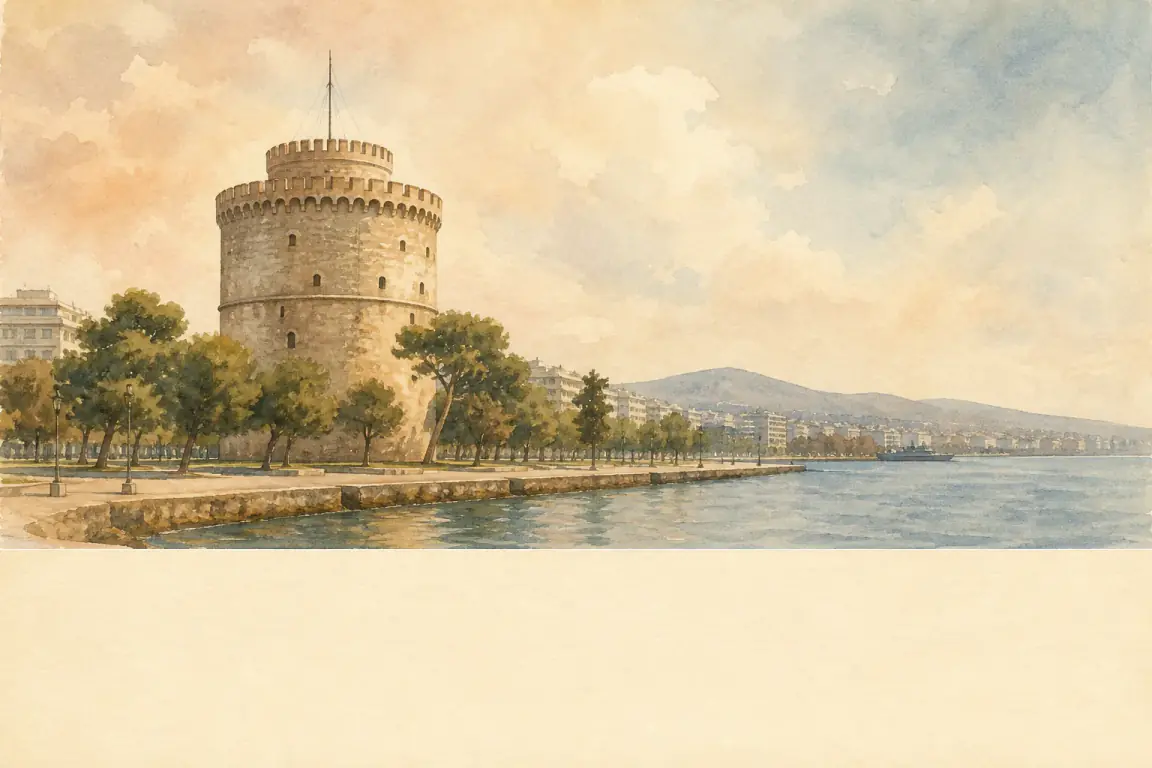
Thessaloniki holidays
Sea-facing northern Greek city break mixing a long waterfront with uphill historic districts.
Prices on this page are shown from the UK. Change market
28°C SeptemberBest May, Jun, Aug, Sep2–4 nights
At a glance
- urban city breaks
- food-led weekends
- northern Greece itineraries
Trip cost
- Return flight
- ≈€252
- Stay
- ≈€448
- Food & local
- ≈€120
Includes the return fare from London Heathrow. An estimate, not a quote — each booking happens separately with its supplier. How we work this out.
Prices shown on this page are indicative estimates in euros, not quotes. Every booking happens separately with its own supplier, at that supplier's own live price. How we work this out.
Stays
Stays in Thessaloniki
From €64/night · Typical €92 · 206 stays · 4-night stay assumed

- Best 3-starCastra Garden House Private Parking2.5 km from the centre€117 a night (opens in a new tab)
See more 3-star options
- Best 4-starCity2.5 km from the centre€108 a night (opens in a new tab)
See more 4-star options
- CheapestStudio Kastra2.4 km from the centre€64 a night (opens in a new tab)
See more options, cheapest first


Map
Review or change this anytime on our privacy page.
Self-catering
Prefer a place of your own? Browse holiday homes and apartments in Thessaloniki on Holidu.
Getting to Thessaloniki
- AirportThessaloniki Airport Makedonia (SKG)
- Transfer optionsBus, taxi
Thessaloniki Airport Makedonia connects to the centre by the 01X/01N bus (signed X1/N1 by the municipality), which runs every 30 minutes and takes roughly 40 to 50 minutes to the city centre, the new railway station and the main bus terminal, for a flat €2 fare; taxis are also available outside arrivals.
Indicative, per traveller. You book with Aviasales.
Areas of Thessaloniki
A few places people base themselves, and who each tends to suit.
- Waterfront / Nea ParaliaBest for visitors wanting long seaside walks and modern hotels along the promenade, with the most central bus and tram connections into the rest of the city.
- LadadikaSuits travellers who like compact quarters with restaurants and bars near the port area, and who'd rather walk to dinner than take transport.
- Ano Poli (Upper Town)Appeals to those happy with hills and steps in exchange for views and a more historic feel; less practical for short stopovers or anyone prioritising step-free access.
- City Centre around Aristotelous SquareWorks for first-time visitors who want easy access to shops, cafes and bus routes, and the shortest walk to both the waterfront and Ladadika.
Thessaloniki weather by month
Thessaloniki is warmest in July, when daily highs average 34°C, and coolest in January at 12°C. December is the wettest month at about 110 mm, August the driest at 29 mm. Taking warmth and rainfall together, May, June, August, September score best for a trip.
- Best overall
- May · June · August · September
- Hottest
- July · 34°C
- Wettest
- December · 110mm
- January: average daily high 12°C, 75mm rainfall.
- February: average daily high 13°C, 31mm rainfall.
- March: average daily high 15°C, 68mm rainfall.
- April: average daily high 19°C, 66mm rainfall.
- May: average daily high 24°C, 71mm rainfall. Good month for weather.
- June: average daily high 31°C, 53mm rainfall. Good month for weather.
- July: average daily high 34°C, 33mm rainfall.
- August: average daily high 33°C, 29mm rainfall. Good month for weather.
- September: average daily high 28°C, 52mm rainfall. Good month for weather.
- October: average daily high 22°C, 76mm rainfall.
- November: average daily high 17°C, 86mm rainfall.
- December: average daily high 13°C, 110mm rainfall.
How these figures are worked out
Monthly averages — multi-year historical data, not a standard 30-year climate normal or a forecast. Gold months are the best weather fit: each month scores on how close its average daily high sits to about 27 °C, with heavy rainfall counting against it, and months far outside that range are not ranked at all.
What each season is like
- Spring
- April and May warm quickly, from a 14C to 19C average; pleasant for the waterfront and Ano Poli's climbs before the heat sets in.
- Summer
- July and August run hot, with average highs of 32-34C and city-centre humidity that makes exposed concrete streets tiring by afternoon; the waterfront stays busiest and liveliest after dark.
- Autumn
- September averages 22C with highs near 27C while rainfall is still well below the winter peak, arguably the most comfortable stretch for walking; by November, averages drop into the low teens and rain increases again.
- Winter
- December to February average highs of 11-13C, with December the year's wettest month, so the city keeps functioning but waterfront walks and hillside views are a wetter, greyer version of the same route.
What’s on in Thessaloniki
 Fri 25 SeptΟ ΦΟΝΙΑΣ - ΕΓΚΛΗΜΑ ΚΑΙ ΑΘΩΩΣΗ | ΘΕΣΣΑΛΟΝΙΚΗ
 Sat 26 SeptSLOMOSA | Thessaloniki
 Wed 30 SeptΜίλτος Πασχαλίδης - Θεσσαλονίκη
 Sat 3 OctΛόγος Τιμής live στην Θεσσαλονίκη
See all events in Thessaloniki on Wanderistan (opens in a new tab)
Compare Greece destinations
Still deciding? Other Greece destinations, with the same weather and typical-stay data behind them.
Nearby and alternative destinations
Nearby — reachable overland
- Skopje~197km straight-line
Also consider
More from the UK
Good to know about Thessaloniki
Why go
- Offers a compact urban base on the Thermaic Gulf instead of the island setting many Greek holidays use.
- Combines waterfront promenades with neighbourhoods like Ladadika and Ano Poli that feel more local than central Athens.
- Useful starting point for trips into northern Greece or Halkidiki rather than the Cycladic islands.
- Flights here run similar in length to reaching many western Mediterranean cities, which makes it a realistic long weekend rather than a trip that needs a full week to justify the flight.
- Halkidiki's beaches are reachable without a car: KTEL Chalkidikis runs its own terminal out on the Nea Moudania road, with coaches along the Kassandra peninsula through the day — enough to make a single beach day workable from a city base. Sithonia, the middle peninsula, is served too, but on a noticeably thinner schedule and reaching much further out, so it repays an overnight more than a day return.
- Litochoro, the walking base below Mount Olympus, sits on the regional railway — but the station is several kilometres from the village, down by the sea, and a taxi rather than a bus covers the gap. The village and the lower gorge make a realistic day; the peaks themselves need far longer. Vergina's royal tombs and Pella's mosaics are served by regional coaches on thin schedules — reachable, but worth checking departures before committing a day to them. Meteora is a long day from Thessaloniki and is commonly done as one, though an overnight turns a rushed dash into a proper visit.
- The Rotunda, the Arch of Galerius, the Roman Forum and the Byzantine walls are part of a UNESCO World Heritage listing, so the city's Roman and early Byzantine layers are a specific set of sights to build a walking day around rather than a general atmosphere.
Worth knowing
- Hilly areas like Ano Poli involve steep streets and may not suit all mobility levels.
- Sea access near the centre is promenade-focused rather than beach-focused; swimming requires travel to nearby coasts.
- Traffic and parking can be challenging in central neighbourhoods.
- Summer heat combined with concrete-heavy areas may feel tiring for some visitors.
- Greece is in the Schengen area, so UK passport holders can stay without a visa for up to 90 days in any 180-day period; first entries now go through the EU's Entry/Exit System, which adds a biometric photo and fingerprint check for UK arrivals.
Source: UK Foreign, Commonwealth & Development Office (gov.uk) (opens in a new tab), checked
Official references
Authoritative pages worth checking before you go to Thessaloniki.
- KTEL Chalkidikis coach routes to the Kassandra and Sithonia beaches (opens in a new tab) — KTEL Chalkidikis
- Hellenic Train timetables for the Thessaloniki regional lines (opens in a new tab) — Hellenic Train
- Paleochristian and Byzantine Monuments of Thessalonika (opens in a new tab) — UNESCO World Heritage Centre